What Does One Second Cost at Scale?
15 October 2026
Why small operational improvements can deliver significant commercial value.
In business, one second doesn’t sound particularly important.
One second to scan a barcode. One second to apply a label. One second to handle, identify or process an item.
Individually, these moments appear insignificant.
But what happens when they’re repeated thousands, hundreds of thousands or even millions of times?
Suddenly, one second becomes a significant commercial opportunity.
The mathematics of marginal improvement
Imagine a distribution operation processing 10 million items annually.
Through a relatively simple improvement to its labelling or handling process, the business manages to eliminate just one second of unnecessary activity per transaction.
The potential impact?
- 1 second saved per transaction.
- 2,778 hours of operational capacity released annually.
- £55,556 in potential labour capacity value, based on an illustrative fully loaded labour cost of £20 per hour.
That’s the equivalent of more than 347 eight-hour working days.
All from one second.
Of course, releasing operational capacity doesn’t automatically translate into a direct financial saving. The commercial benefit depends on whether that time can be used to increase throughput, reduce overtime, avoid additional resource requirements or improve productivity.
But the principle is compelling.
Small improvements, repeated at scale, can create substantial value.
The hidden cost of doing things the same way
Many businesses invest considerable time negotiating purchase prices, reviewing supplier costs and challenging individual product specifications.
All important activities.
But how often do we challenge what happens after the product has been purchased?
Consider something as straightforward as a label.
Its purchase price might represent a relatively small proportion of the overall operating cost. Yet its design, specification, presentation and performance can directly influence the efficiency of the process in which it’s used.
A barcode that doesn’t scan first time.
A label that’s difficult to remove from its backing.
An adhesive that doesn’t perform consistently.
A format that requires unnecessary handling.
An interruption caused by poor stock availability.
Individually, these issues may seem relatively minor.
Across a high-volume operation, their cumulative impact can be considerable.
And that’s where looking beyond the product becomes important.
From supplying products to improving processes
At GBF, we believe the role of a good supply partner extends well beyond responding to enquiries and delivering products.
Our approach to Solutions Management starts with understanding how our customers operate.
Not simply what they buy, but why they buy it, how they use it and what they’re ultimately trying to achieve.
That means asking different questions.
Could a change in label format reduce application time?
Could better barcode quality improve scanning reliability?
Could alternative materials reduce waste or rework?
Could improved stock management prevent unnecessary interruptions?
Could a small change in specification make a repetitive task easier, faster or more reliable?
Sometimes the answer involves a different product.
Sometimes it’s a change in process, a smarter stock arrangement or a more appropriate specification.
And sometimes the existing solution is already the best one.
The objective isn’t simply to sell something different. It’s to identify opportunities to deliver something better.
A different way to measure value
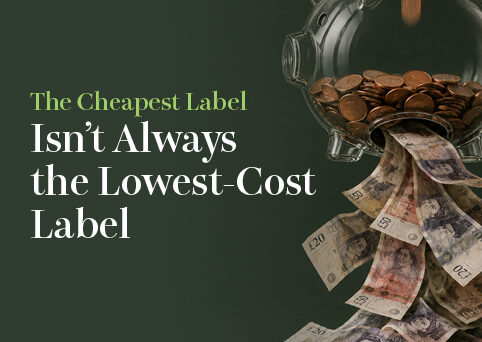
The true commercial value of a product isn’t always reflected in its purchase price.
A label that costs marginally more but improves operational efficiency may ultimately deliver greater value than a cheaper alternative.
Equally, a small adjustment to an existing product might unlock improvements without any significant additional investment.
This is why we believe meaningful supplier relationships should be built around understanding operational challenges, identifying opportunities and delivering measurable improvements.
It’s a partnership approach rather than a transactional one.
And it requires suppliers to take an active interest in the wider performance of their customers’ businesses.
One second is just the beginning
The example of one second is deliberately simple.
But the principle extends far beyond time alone.
Reduced waste. Improved reliability. Better stock availability. Fewer errors. Increased throughput. More efficient use of resources.
Each represents an opportunity to improve operational performance.
And when those improvements are multiplied across a large-scale operation, the potential commercial benefits become increasingly significant.
At GBF, this is the thinking behind our Solutions Management approach.
Because sometimes the greatest opportunity isn’t found in negotiating a lower unit price.
It’s found in understanding what happens to that product millions of times after it’s purchased.
More than labels. A better partner.
At GBF, we work with customers to understand their operations, challenge existing approaches and identify practical opportunities for improvement.
Could a small change make a significant difference to your operation?
Let’s have a conversation.
GBF | Labels, Print & Packaging Specialists
Illustrative calculation: 10,000,000 transactions × 1 second = 10,000,000 seconds, equivalent to approximately 2,778 hours. At an assumed fully loaded labour cost of £20 per hour, this represents approximately £55,556 in potential labour capacity value. These figures illustrate the opportunity rather than a verified GBF customer result or guaranteed financial saving.